
Everyone promised that AI would fix scope creep. Faster estimates, smarter planning, fewer surprises. So why do project teams in 2026 feel like scope creep is spreading faster than ever?
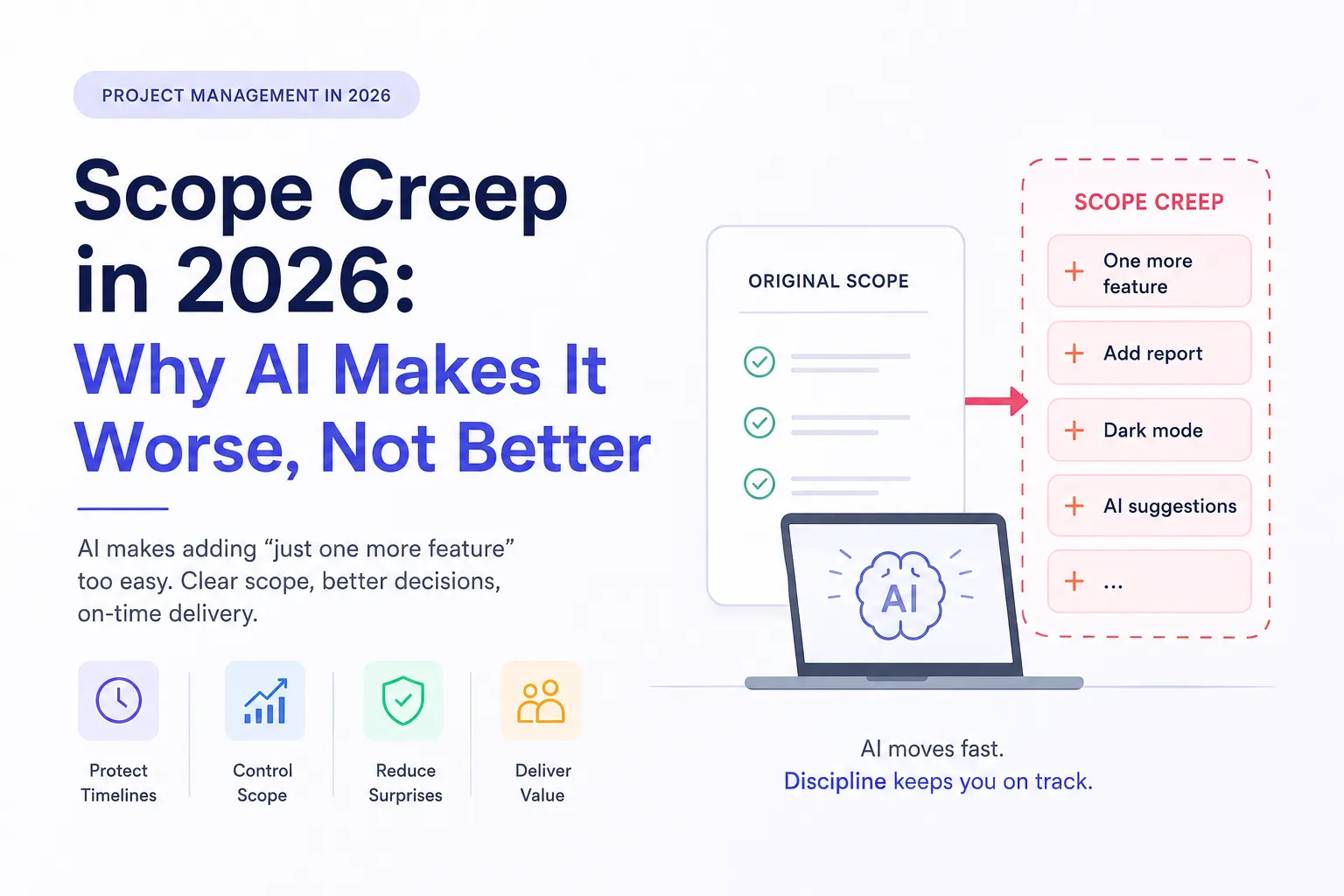
Scope Creep in 2026 isn’t disappearing because of AI — it’s getting worse. AI tools make it dangerously easy to add “just one more feature” because building feels instant and cheap. But speed isn’t the same as clarity. Teams still need real scope discipline, clear requirements, and human judgment to keep projects on track. This blog breaks down why AI-assisted development is quietly fueling scope creep, and what teams can actually do about it.
What Is Scope Creep, Really?
Scope creep happens when a project slowly grows beyond its original goals — new features, new requests, new “quick fixes” — without anyone officially agreeing to the extra time or cost. It rarely shows up as one big change. It’s death by a thousand small ones.
In theory, AI should have solved this. Automated planning tools, AI-assisted estimation, and smart project trackers were supposed to catch scope changes early and keep teams honest. Instead, something unexpected happened.
Why AI Is Fueling Scope Creep, Not Fixing It
1. Building Feels Free, So Everyone Asks for More
AI coding assistants can spin up a new feature, a new screen, or a new function in minutes. When something feels fast and cheap to build, stakeholders stop asking “should we?” and start asking “why not?”
This is the core problem of Scope Creep in 2026 — the psychological cost of asking for “one more thing” has dropped to almost zero, even though the real cost (testing, maintenance, integration, security) hasn’t gone anywhere.
2. AI Makes Bad Ideas Look Polished
A rough idea typed into an AI tool can come back looking like a finished feature — clean code, a working demo, even documentation. That polish creates false confidence. Teams greenlight additions that were never properly scoped, simply because the AI output looked production-ready.
3. Nobody Owns the “No” Anymore
Traditionally, a product manager or team lead acted as the gatekeeper for new requests. But when developers can quietly prototype a stakeholder’s side request using AI over a lunch break, that gate disappears. The feature exists before anyone had the chance to say no.
4. AI Encourages “Just Try It” Culture
AI lowers the barrier to experimentation, which is great for innovation but terrible for scope control. Teams start layering in AI-suggested improvements, extra edge cases, and “smart” enhancements that were never part of the original plan — and suddenly the two-week sprint becomes a six-week sprint.
5. Estimation Tools Still Can’t Read Minds
AI-powered estimation tools are only as good as the requirements fed into them. If the scope itself is vague, AI will confidently generate an estimate for the wrong thing. This gives teams a false sense of precision, which makes it even harder to notice when scope has quietly expanded.
The Real Cost of AI-Driven Scope Creep
- Missed deadlines that “shouldn’t have happened” given how fast AI tools work
- Ballooning QA and testing cycles as untracked features pile up
- Burnout, as developers absorb “small” requests that add up to major overtime
- Budget overruns that are hard to explain because no single change looks big on its own
- Lower software quality, since AI-generated additions often skip proper review
This is the quiet danger of Scope Creep in 2026: it doesn’t look like chaos. It looks like productivity, right up until the project is three months late.
How Teams Can Actually Fight Back
Set an AI Usage Boundary for New Features
Any feature idea generated with AI — no matter how good it looks — should go through the same approval process as a manually proposed one. Speed of creation should never skip the step of scope approval.
Bring Back a Single Point of “No”
One person (or a small change-control group) should own scope decisions. If a request didn’t go through them, it doesn’t go into the sprint, AI-built or not.
Track Scope Changes Like You Track Bugs
Every added feature, no matter how small, should be logged. This is exactly where good QA and bug-tracking discipline pays off — the same rigor that catches software defects can catch scope drift before it catches you.
Separate “Demo-Ready” From “Release-Ready”
Teams need to remember that an AI-generated prototype is not a finished feature. Build in a clear checkpoint between “this looks cool” and “this ships.”
FAQ: Scope Creep in 2026
Is scope creep worse with AI tools, or does it just feel that way?
It’s genuinely worse. AI reduces the effort needed to add features, which increases how often “small” additions get requested and approved without proper review.
Can AI project management tools prevent scope creep?
They can help track changes, but they can’t enforce discipline. Scope creep is a people and process problem first, a tooling problem second.
What’s the biggest mistake teams make with AI and scope?
Treating a fast AI-built prototype as if it were already scoped, tested, and approved for release.
How can small teams manage this without slowing down innovation?
Keep experimentation and production separate. Let people prototype freely with AI, but require every idea to pass through a lightweight approval step before it enters the actual roadmap.
Conclusion
AI didn’t cause scope creep, but it did remove the natural friction that used to slow it down. In 2026, the teams that stay on schedule won’t be the ones with the best AI tools — they’ll be the ones with the clearest boundaries around how those tools get used. Scope Creep in 2026 isn’t a technology problem. It’s a discipline problem, and discipline is something no AI model can generate for you.



Leave a Reply