
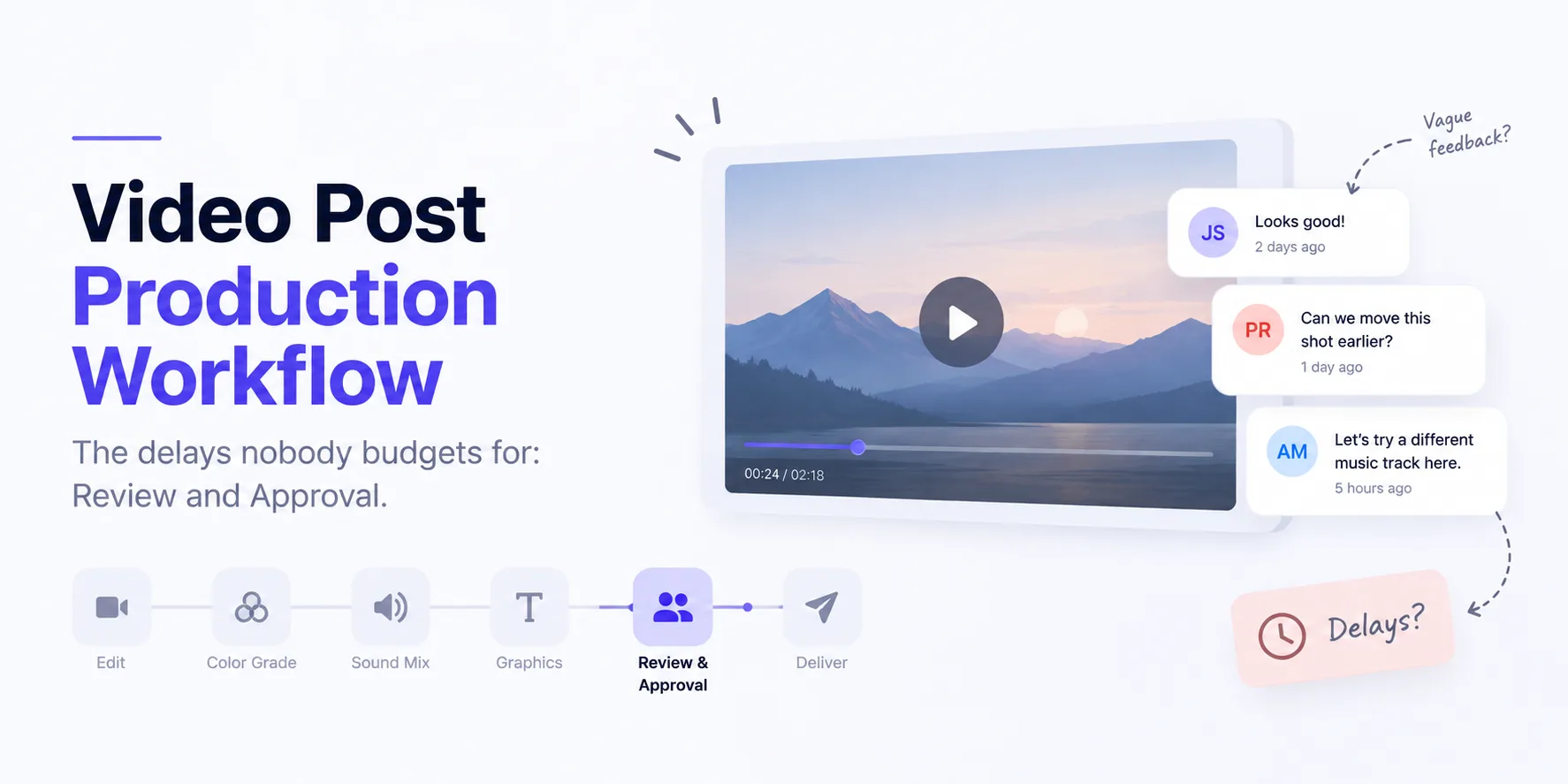
Most delays in a video post-production workflow don’t come from editing, colour grading, or rendering — those steps have predictable timelines. The real slowdowns happen during review and approval, where vague feedback, scattered comment threads, and slow decision-makers can turn a two-week edit into a two-month drag. This blog breaks down which review stages cause the worst delays, why they happen, and how to fix them without hiring more editors or buying faster machines.
If you’ve ever finished a rough cut on Tuesday and still been waiting for “final approval” three weeks later, you already know the problem. A 2026 Wyzowl survey found that nearly half of businesses using video marketing cite unclear timelines as a top source of project friction — and industry reporting suggests roughly two-thirds of unplanned revision rounds are caused by vague or late feedback rather than by the editing work itself. The video post production workflow looks tidy on paper, but the review loops between each stage are where projects quietly bleed time. Understanding those loops is the difference between hitting a launch date and explaining, again, why you missed it.
What a Typical Video Post-production Workflow Looks Like
Before we get into where things break, here’s the standard flow most teams follow:
- Ingest and organise — Footage is imported, labelled, and backed up.
- Rough cut — The editor assembles a first draft of the story.
- Fine cut / picture lock — Pacing, structure, and shot choices are finalised.
- Colour grading — The look and mood are dialled in.
- Sound design and mix — Dialogue, music, effects, and mastering.
- VFX and graphics — Titles, motion graphics, and any visual effects.
- Final QC and delivery — Export in the required formats and hand off.
Each of these steps has a fairly known duration. A skilled colourist can quote you hours. A sound mixer can quote you days. But between every one of these steps sits a review gate — and that’s where the schedule quietly falls apart.
Where the Video Post Production Workflow Actually Breaks Down
The three review checkpoints that eat the most time are almost always the same, regardless of project size or budget.
1. Rough cut approval
This is where clients or producers see the story for the first time. Instinctively, they want to reshape it. Emails come in with “can we move the interview earlier?” or “the intro feels slow” without any timecodes attached. The editor spends hours guessing which shot each note is about. One round of vague feedback can add three days to a schedule that had one day set aside for revisions.
2. Fine cut and picture lock
By this stage, the structure should be settled. But this is also when stakeholders who missed the rough cut suddenly join the review. New voices raise old questions. The editor is now unpicking decisions that were already signed off, and version numbers start climbing — v4, v5, v5_final, v5_final_REAL.
3. Final QC and delivery sign-off
This looks like a formality but rarely is. Someone spots a typo in a lower-third at 4 p.m. on delivery day. Someone else wants to swap the background music. Because the file has technically been approved, nobody wants to be the person delaying delivery, so the fix happens in a panic and quality slips.
The Specific Behaviours That Cause the Delays
If you look closely, the pattern behind every delayed review is one of these:
- Vague feedback with no timestamps. Notes like “the middle feels off” force the editor to interpret before they can act. Industry reporting attributes around 67% of unplanned revision rounds to feedback like this.
- Feedback scattered across channels. Comments arrive by email, Slack, WhatsApp, and Zoom recordings. Nobody has a single source of truth.
- Too many reviewers, no clear decision-maker. When five people leave conflicting notes, the editor waits for someone to settle the tie.
- Timezone gaps. A 30-second question can cost 24 hours of calendar time if the reviewer is on the other side of the world.
- Version chaos. Reviewers watch old cuts by accident and leave notes on issues that were already fixed.
- No deadlines on the reviewer. Editors always have due dates. Reviewers usually don’t.
How to Remove Review Delays From Your Workflow
The fix isn’t more editors or faster software. It’s shrinking the review loop itself. A few practical moves that consistently work:
- Put all feedback in one place, directly on the video. Instead of typed notes in a document, let reviewers click on the frame and leave a comment tied to that exact timestamp. Tools like BugSmash are built for this — reviewers pin comments straight on the video, so the editor sees the shot and the note together, with no guesswork.
- Set a review SLA. Give reviewers a 48-hour window. If they miss it, the cut moves forward. This one rule eliminates most rolling delays.
- Name one final approver. Group feedback is fine, but only one person signs off. Everyone else advises.
- Batch feedback rounds. Two structured rounds beat six informal ones. Announce the rounds up front so reviewers save their notes for the right stage.
- Version-lock the review link. Reviewers should only ever see the current cut, not older uploads sitting in someone’s inbox.
FAQs
Q: How long should video post-production actually take?
For a standard 2–3 minute corporate or marketing video, most studios budget two to four weeks for post-production, including two review rounds. Simple talking-head edits can close in one to two weeks; anything longer usually points to review delay, not editing time.
Q: Who owns the review process — the editor or the client?
The producer or project manager owns it. Editors execute, clients respond, but someone has to enforce deadlines and consolidate notes. Without that role, review always drags.
Q: What’s the single biggest cause of missed delivery dates?
Late-arriving stakeholders. New reviewers joining after picture lock reopen closed decisions and force rework that was never scoped.
Q: Can review tools really cut delivery time?
Yes, meaningfully. Vendors in this space publish that teams using structured, in-video review report roughly 30% fewer revision rounds and around a one-third reduction in approvals-related meetings. Individual case studies go higher — Filestage’s Fanuc case, for example, cites 10 days saved per project once V1-to-approval moved into a single dashboard.
Wrapping Up
The creative side of a video post-production workflow is not usually what makes projects late. Editing, grading, and mixing are craft — and craft has predictable timelines. The unpredictable part is the human review loop wrapped around each stage. Fix the review, and the whole schedule tightens by itself. Fewer reviewers, one clear approver, timestamped feedback, and firm deadlines will do more for your delivery date than any new plugin or export preset ever will.



Leave a Reply