The work
Behind the Practice is a one person digital marketing agency in Indianapolis serving physical therapy clinics. Jordan designs and builds their websites and app experiences, which means a steady stream of designs going out for client review and coming back with notes.
Clinic owners are not designers, and they are not sitting at a desk waiting to review a mock-up. Whatever the feedback process is, it has to survive being used by a busy person between patients.
The problem
Before BugSmash there were two options, and neither was good. Clients took screenshots and described what they meant around them. Or Jordan tried to build a custom feedback tool himself, which never quite worked.
It was clunky and kind of frustrating for clients to provide feedback. Since it was difficult to provide feedback I feel like I received less of it.
That second sentence is the one worth sitting with, because it is the part most agencies never measure. Friction in a review process does not just slow feedback down. It suppresses it. A client who has to take a screenshot, crop it, write a paragraph explaining where they mean and email it will mention the three things that really bother them and quietly let the other seven go.
Those seven do not disappear. They surface at the next round, or after launch, as a revision.
What changed
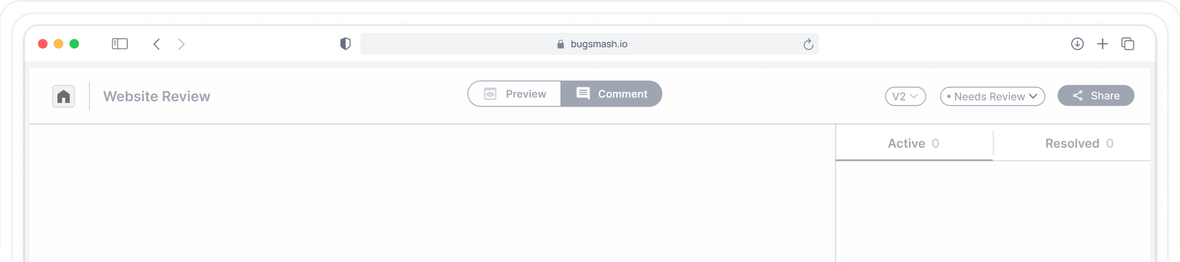
What sold him was not a feature list. It was the simplicity. Point BugSmash at a website, send a link, get feedback almost immediately.
Onboarding was smooth. He hit some difficulty with a Bubble.io project, raised it, and got a response he describes in capital letters: the team has been AMAZING at responding to feedback.
The moment it was obvious
One project in particular. Jordan used Claude to design and mock something up, then put it straight into BugSmash and sent it to the client for feedback. His estimate is that the combination sped up the process by 50%.
The interesting part is what he noticed afterwards, which he had not gone looking for.
One hidden benefit that I hadn't considered is it greatly prevents scope creep.
It follows from the same mechanism as the original problem, running the other way. When a comment is attached to a specific element at a specific moment, the change being asked for is specific too. Vague feedback is what expands into scope creep, and a pinned comment is the opposite of vague.
The result
Revision rounds down by around 30%, on his own estimate. On the one project where he paired an AI mock-up with a BugSmash review link, half the cycle time gone.
He is measured about the bigger picture, and it is worth quoting the shape of his answer rather than dressing it up. Asked whether it changed his business in a larger way, he said not really. But he immediately added that decreased scope creep is always nice as far as budgeting and keeping projects profitable.
For an agency of one, that is not a small footnote. Scope creep is the thing that turns a profitable project into an unprofitable one, and it is almost never a single big request. It is a slow accumulation of small unclear ones.
Asked what he would do if BugSmash disappeared tomorrow, his answer doubles as a review of the alternative: he would probably try to build something himself, honestly, but he would rather not have to do that.
I'd recommend BugSmash to any agency / marketing companies. It has been a fantastic tool for providing client feedback in an easy and quick way.
 Jordan ClevengerFounder, Behind the Practice
Who he would tell
Agency work, and especially anything involving marketing visuals. Which is to say: any team whose output is something a client has to look at and have an opinion about.
Case study prepared with Jordan Clevenger of Behind the Practice. Published with his permission.