Publish to staging
Publish to yoursite.webflow.io and paste that URL into BugSmash. On a free, unhosted site there is no password to set, so staging is reachable straight away.

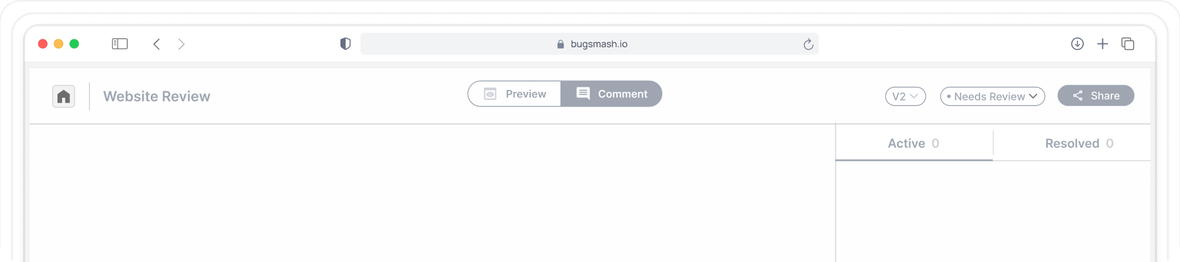
Paste the URL, send one link. Your client pins comments straight onto the page, at any breakpoint, and every comment arrives with the element, the browser and the device it came from.


Loved by1,250+Agenciesand companies in 100+ countries
If your reviewer is inside your Workspace looking at the Designer canvas, use Webflow's own commenting. It pins to elements, it works per breakpoint, and reviewer seats are free. It is built for the build.
Four things sit outside it:
Webflow comments are a Designer-level feature. A stakeholder with Edit access does not see them the same way, and a client who is not in the Workspace at all sees nothing. What your client wants to react to is the published page, loading in their own browser, at their own screen size.
Comments added on a page branch are permanently deleted when the branch is merged. The whole history lives inside the Webflow site, so when the site is handed over, rebuilt or the subscription lapses, the review trail goes with it.
Elements that only appear inside an interaction, and content inside custom code embeds, are not commentable on canvas. On a Webflow build those are frequently the exact things the client wants to talk about.
The launch deck, the campaign PDF, the product video, the ad images and the email template are all part of the same delivery and none of them are in Webflow.
 BugSmash starts where that stops:
How it works
Publish to yoursite.webflow.io and paste that URL into BugSmash. On a free, unhosted site there is no password to set, so staging is reachable straight away.
Your client opens it in their own browser. They click any element to drop a pin and type. No Webflow seat, no BugSmash account, no extension.
Every comment carries the page, the element, the breakpoint, the browser and a screenshot. Assign it, set priority, or push it into Jira, ClickUp, Monday, Asana, Trello or Slack.
Comments attach to the thing on the page, so "this heading" is unambiguous without a marked-up JPEG in an email.
Desktop, tablet and mobile in the same link. Responsive is most of the job on a Webflow build, so a desktop-only review is half a review.
Blog posts, case studies, product templates. Each published Collection page is a URL, so each one is reviewable.
Every comment records what the reviewer was on. No follow-up thread to work out why you cannot reproduce it.
Republish, add a new version, and compare against what the client signed off on last round.
Who approved, on which version, on what date. That record stays with you, not with the Webflow site.
The review window loads the page in a real browser session, so anything you can sign in to yourself, you can sign in to here. Nothing is handed over to BugSmash and no credentials are stored.
| Your URL | Review by URL | What to do |
|---|---|---|
| yoursite.webflow.io staging | Works | Paste and go. On a free, unhosted site there is no password to set, so staging is reachable by default. |
| Published custom domain, public | Works | Paste and go. |
| Site or page password on a paid Site plan | Works | The review window is a real browser. When Webflow's password gate appears, sign in there and carry on. |
| Membership or login wall with a username and password form | Works | Same as above. Sign in inside the review window. |
| Sign in with Google, Microsoft, or any social or SSO login | Not supported | There is no password to pass through. Install the Feedback Widget. |
| Heavy Interactions, Lottie, scroll effects, WebGL | Renders, fidelity varies | For animation-heavy builds, install the Feedback Widget so the page runs in its own environment. |
Paste one script into Site settings > Custom code. That needs a paid Site plan, since custom code is not available on the free staging-only setup. Webflow publishes custom code to whatever you publish, so if you added the widget for pre-launch review, remove it before the production publish.
From client staging reviews to launch sign-off, keep agencies, marketing teams and studios aligned on the published site.

Client reviews the staging URL, you work a list instead of a thread, and the sign-off is recorded against a version you can point back to when scope is disputed.
See how
Legal, brand and the product lead all review the same published page before launch, without any of them needing a Workspace seat.
See how
Review a Webflow site you did not build and have no Designer access to, which is every audit, every pitch and every takeover project.
See howA comment on the hero section becomes a ticket with the URL, the element, the screenshot and the browser already attached.
Context stays attached from comment to completion.
Send to your workflow
The destination changes. The context does not.
 Jira
Jira ClickUp
 Monday
 Asana
Asana Trello
 Slack
Slack Linear
 Todoist
 Notion
 Airtable
 Zapier
 Make
Make n8n
n8n Webhooks
A Webflow launch is rarely only a Webflow launch. The same project holds the pitch deck, the brand PDF, the launch video, the ad creative, the email template and the mobile build, each reviewed the same way, each on the same approval record.

 MayaMake this hero image full-bleed
 product-launch.mp4
 LeoTrim the intro to 0:03
 AvaSmooth these edges a bit
 SamUpdate the Q3 numbers
 Up to 40% off
 NoahStronger CTA copy here
 ZoeAlign the chart legend
This year marked our strongest period of growth to date. Revenue climbed 42% year over year while our customer base expanded across eleven new markets, driven by continued investment in product.

Operational efficiency improved as automated workflows reduced manual review time by nearly a third. Looking ahead, we plan to double down on infrastructure, deepen key partnerships, and ship the roadmap our customers have been asking for.
 EllaTighten this paragraph
 TheoBoost the warm tones
 MiaCut the dead air at 1:12
No. Paste the published URL and BugSmash generates a review link. It does not connect to your Webflow Workspace, does not need Webflow API access and cannot change anything in the Designer. The Feedback Widget is optional and only needed for pages behind a social or SSO login, or for animation-heavy builds.
Paste your Webflow URL and send the first review link in under a minute.