Build and deploy the intended revision
Run docusaurus build and publish the build directory with the url, baseUrl, and trailingSlash settings intended for that host.

Paste the browser-accessible URL for the deployed documentation site, send one review link, and collect comments on the static pages your readers will actually browse.


Loved by1,250+Agenciesand companies in 100+ countries
Docusaurus generates static production files, while the project team chooses how and where those files are hosted. BugSmash reviews the resulting browser-accessible deployment.
Four documented build and routing details shape the review:
Running docusaurus build generates the static production files in the build directory. Docusaurus leaves the choice of host to the project team.
The serve command previews the built site locally and uses localhost on port 3000 by default. It is not a durable external review address.
Docusaurus requires url for the site origin and baseUrl, with a trailing slash, for the path where the project is served.
The trailingSlash setting changes generated URLs, links, and emitted filename patterns. Docusaurus notes that static hosts can handle these patterns differently.
 BugSmash adds a review layer around that deployed output:
How it works
Run docusaurus build and publish the build directory with the url, baseUrl, and trailingSlash settings intended for that host.
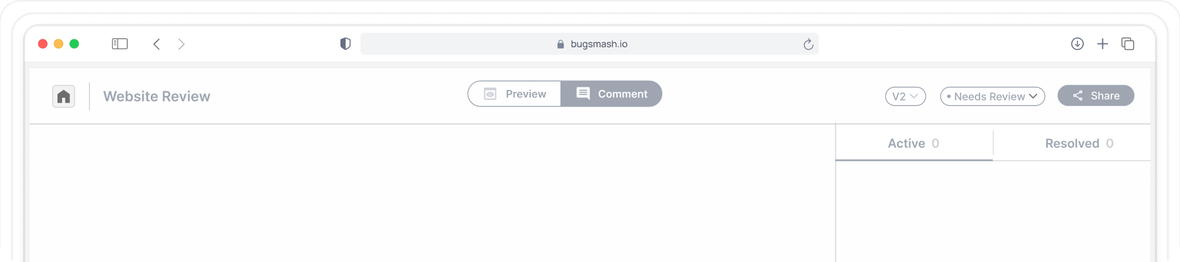
Paste the deployed site URL into BugSmash and share the generated link. Reviewers work on the rendered documentation rather than the repository or local server.
Use each comment's page, selected location, screenshot, browser, operating system, and viewport context to update and redeploy the site.
Attach each note to the deployed page instead of translating it into a Markdown file, React component, or route name.
Review the full deployed path after url and baseUrl are configured for the hosting location.
Collect feedback at desktop, tablet, and mobile viewport sizes with that viewport kept in the report.
Keep the page URL, screenshot, browser, operating system, and viewport with every website comment.
Check the deployed asset URLs after files from the static directory have been copied to the root of the build output.
Use the browser URL supplied by the chosen host without treating any one hosting provider as required by Docusaurus.
BugSmash needs the deployed result to be reachable in the reviewer's browser. Source files and local-only addresses are not external review surfaces.
| Your URL | Review by URL | What to do |
|---|---|---|
| Public Docusaurus site on a custom domain | Works | Paste the deployed documentation URL and start the review. |
| Public deployment supplied by a static host | Works | Use the host's browser-accessible URL after confirming the intended revision is deployed. |
| Docusaurus site below a base path | Works | Use the full deployed path and confirm url and baseUrl match that location. |
| Site protected by supported Basic Auth | Works | Use the browser-accessible Basic Auth URL; BugSmash lists Basic Auth-protected websites as supported. |
| Site behind application login or SSO | Use the Widget | Pasting a URL does not bypass application login or SSO. If the script can be installed on the rendered site, use the Feedback Widget inside the authenticated browser session. |
| Local docusaurus serve address | Not directly | Deploy the build directory to an accessible host before creating the external review. |
Where the rendered site permits the BugSmash script to be installed, use it when authorized reviewers need to comment inside an authenticated or stateful frontend. Their existing access still controls which pages they can open.
Keep documentation source, static hosting, and stakeholder approval distinct while everyone reviews the same deployed pages.

Review navigation, copy, code examples, and generated pages without requiring every stakeholder to use the source repository.
See how
Collect visual feedback with the exact page, selected location, browser, screenshot, and viewport attached.
See how
Validate base paths, links, assets, and host-specific trailing-slash behavior on the intended deployment.
See howSend actionable page feedback to the delivery team with its location, screenshot, browser, operating system, and viewport context preserved.
Context stays attached from comment to completion.
Send to your workflow
The destination changes. The context does not.
 Jira
Jira ClickUp
 Monday
 Asana
Asana Trello
 Slack
Slack Linear
 Todoist
 Notion
 Airtable
 Zapier
 Make
Make n8n
n8n Webhooks
Keep the documentation site beside release notes, PDFs, videos, launch graphics, and presentations with one approval trail.

 MayaMake this hero image full-bleed
 product-launch.mp4
 LeoTrim the intro to 0:03
 AvaSmooth these edges a bit
 SamUpdate the Q3 numbers
 Up to 40% off
 NoahStronger CTA copy here
 ZoeAlign the chart legend
This year marked our strongest period of growth to date. Revenue climbed 42% year over year while our customer base expanded across eleven new markets, driven by continued investment in product.

Operational efficiency improved as automated workflows reduced manual review time by nearly a third. Looking ahead, we plan to double down on infrastructure, deepen key partnerships, and ship the roadmap our customers have been asking for.
 EllaTighten this paragraph
 TheoBoost the warm tones
 MiaCut the dead air at 1:12
Run docusaurus build and deploy the generated build directory. Docusaurus documents that directory as its static production output.
Paste an accessible Docusaurus deployment and send a focused review link without sending stakeholders into the repository.